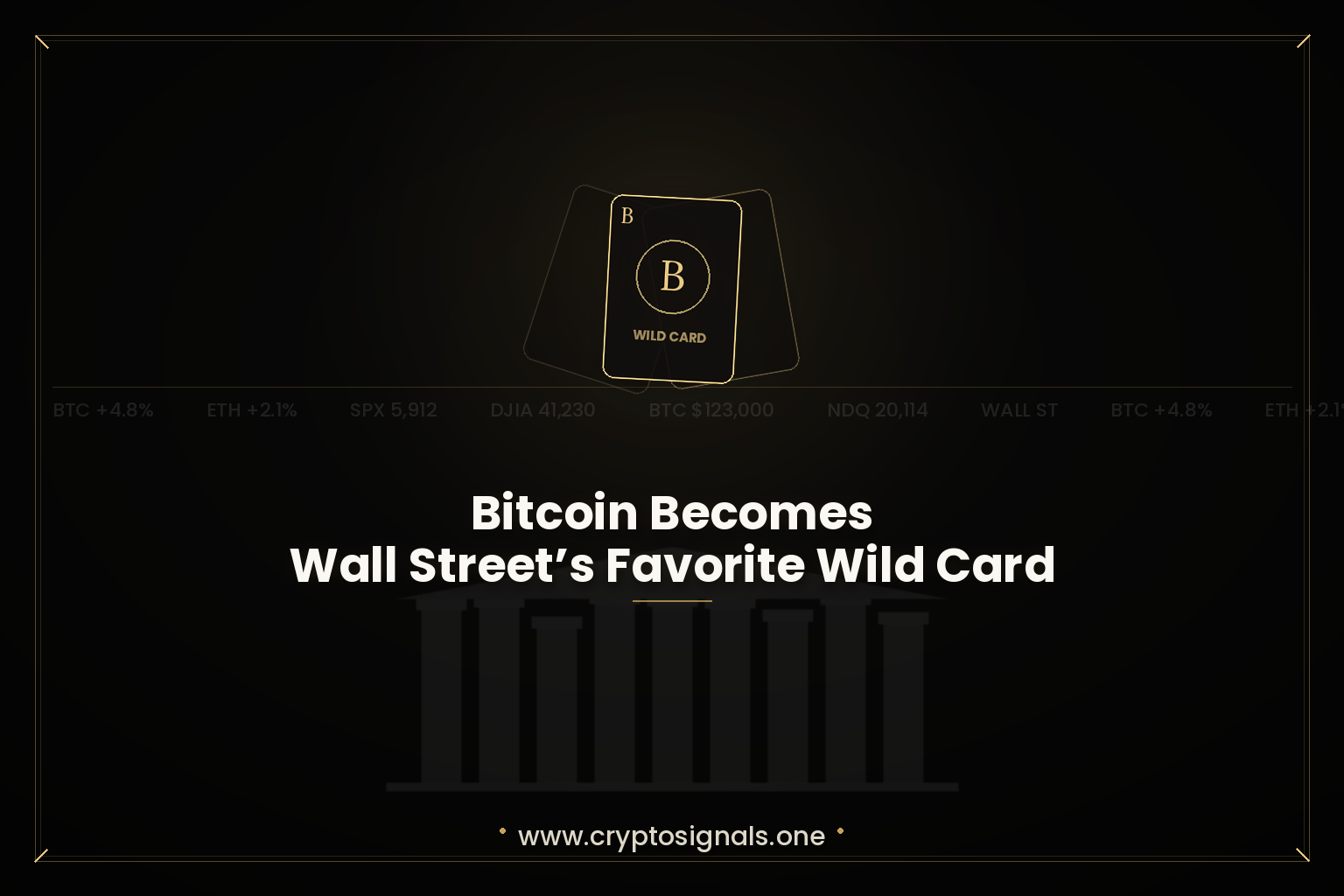
Bitcoin Becomes Wall Street’s Favorite Wild Card
From speculative chaos to strategic allocation, institutions are redefining Bitcoin’s volatility as opportunity, not risk. Bitcoin has flipped the script on Wall Street. While the S&P 500 posted a healthy 25% return in 2024, Bitcoin delivered a staggering 135% . Instead of shying away from the vo...

Live market data
Bitcoin / U.S. Dollar
BTCUSD · Massive · X:BTCUSD
81,381.40 USD
0.00 (0.00%)
Previous
81,381.40
Open
81,379.80
High
81,519.00
Low
81,377.33
Volume
1.347
Updated 18/10/2026, 00:44:05. Market data is informational and may be delayed.
From speculative chaos to strategic allocation, institutions are redefining Bitcoin’s volatility as opportunity, not risk.
Bitcoin has flipped the script on Wall Street. While the S&P 500 posted a healthy 25% return in 2024, Bitcoin delivered a staggering 135% .
Instead of shying away from the volatility that once made it untouchable, professional investors are embracing it — turning Bitcoin into one of the most dynamic components of institutional portfolios.
The numbers don’t lie. Institutional ETF holdings surged 48.8% YoY , reaching 1.86 million BTC by August 2025.
Even more telling: 59% of institutional investors now allocate at least 10% of their portfolios to crypto. Bitcoin has gone from fringe asset to mainstream portfolio pillar.
The Volatility Reset
Bitcoin’s reputation for wild swings isn’t gone, but the context has shifted. In 2024, Bitcoin’s annualized volatility averaged 35.5% — still 4.5x the S&P 500, but well within the range of major tech stocks like Tesla (44–61%) and Netflix (33%).
More surprisingly, stress events have revealed a different dynamic. In April 2025, the S&P 500’s seven-day realized volatility spiked to 169% , dwarfing Bitcoin’s 83% over the same period.
Wall Street suddenly had to ask: is Bitcoin’s volatility maturing while traditional markets destabilize?
Institutional Money Floods In
The ETF boom has made Bitcoin infrastructure-grade. Inflows hit $14.83B in 2025, already topping last year. BlackRock’s IBIT became the fastest ETF to ever reach $80B AUM .
What’s striking isn’t just the inflows but their composition. Advisors now control 50% of institutional ETF holdings , signaling structured allocation strategies rather than short-term hype.
Hedge funds, meanwhile, have scaled back tactical bets — a sign Bitcoin is shifting into the “long-term reserve” bucket.
The corporate side is catching up too. Treasuries holding Bitcoin surged 18.6% YTD , with nearly 2M BTC now sitting on balance sheets. The “MicroStrategy model” is becoming a playbook.
The Correlation Puzzle
Bitcoin’s relationship with traditional markets is no longer one-dimensional. Correlations with the S&P 500 averaged just 0.14–0.17 over the past decade but spiked to 0.9 during major macro shocks and ETF launches.
Yet by mid-2024, Bitcoin broke free again, returning to near-zero correlation as adoption waves and regulatory wins reshaped demand. This regime-shifting behavior is exactly why Bitcoin works as a portfolio diversifier: it’s macro-sensitive when risk-off dominates but maintains independence during crypto-specific catalysts.
Crisis Behavior and Hedge Appeal
During Q1 2025’s market turmoil, Bitcoin fell with equities initially — then recovered faster, driven by network metrics like miner activity and liquidity flows that had no equity-market parallels.
As an inflation hedge, the thesis is strengthening. Bitcoin shows negative correlation (-0.29) with the U.S. dollar and tends to climb during inflation shocks or easing cycles. In currency devaluation scenarios, it has acted as an accessible store of value beyond capital controls — something bonds and equities can’t replicate.
A Maturing Market
Institutional adoption is structurally lowering volatility. Strong hands — retirement funds, sovereign wealth funds, corporate treasuries — are replacing speculative traders. Annualized volatility has fallen 75% compared to early cycles , while regulatory clarity (ETF approvals, legislative wins, banking rails reopening) has stripped away key uncertainty overhangs.
What’s Next
Bitcoin’s rise isn’t about eliminating volatility — it’s about monetizing it intelligently. Portfolio models show even a 1–5% allocation can enhance risk-adjusted returns during inflationary cycles.
The real story: Wall Street no longer sees Bitcoin as chaos. It sees it as a wild card worth playing. A volatile, uncorrelated, globally liquid asset that fits perfectly into the modern allocation toolkit.
Bitcoin is no longer an outsider. It’s becoming part of the system — and its volatility is now a feature, not a flaw
📰 Follow us on Google News for real-time updates on crypto markets, policy shifts, and blockchain innovation.
🚀 Recommended Exchange (Bybit review)
What to compare before acting
Before making a decision about bitcoin becomes wall street’s favorite wild card, compare access in your country, fees, liquidity or execution quality, security controls, withdrawal rules, transparency, and the conditions that apply to the specific product. Marketing claims can change, so verify current terms from the official provider before committing funds.
Key risks and limitations
This article is educational and is not a guarantee or personalized financial advice. Conditions, prices, availability, incentives, and regulations can change. Use conservative risk management and confirm recent information before acting.
Frequently asked questions
Is bitcoin becomes wall street’s favorite wild card suitable for everyone?
No. Suitability depends on your goals, experience, jurisdiction, risk tolerance, and the current terms of the product or platform.
What should readers verify before acting?
Verify current fees, eligibility, risks, withdrawal or cancellation rules, and primary sources. Treat historical examples as context, not promises.
Compare before you trade
More exchange reviews
Access rules, products, fees, and verification requirements can change. Read the review, then confirm the current terms for your country.

KYC profile
Binance
Binance review covering verification, spot and derivatives markets, fees, security, liquidity, and regional availability.

KYC profile
BingX
BingX review covering KYC onboarding, social trading, futures, spot markets, fees, and security.

Non-KYC profile
BitBase
BitBase non-KYC exchange review covering access, fees, security, regional limits, and referral terms.
Exchange comparison
WEEX vs BloFin: a practical Exchange Comparison
Both platforms can appeal to active derivatives traders, but the right choice depends on your region, verification status, product access, total costs and risk controls. The table below is a starting point, not a guarantee of benefits or availability.
| Feature | WEEX | BloFin |
|---|---|---|
| Best fit | Futures first workflow with active trading tools and promotional campaigns. | Derivatives focused workspace with charting and structured risk tools. |
| Trading rewards | Earn 10% cashback on your own eligible trading fees. | Earn 10% cashback on your own eligible trading fees. |
| Weekly events | Weekly trading events and campaigns may be available; check live eligibility. | Weekly trading events and campaigns may be available; check live eligibility. |
| Airdrops and bonuses | Airdrops, bonuses or referral rewards may be offered during selected campaigns. | Airdrops, bonuses or referral rewards may be offered during selected campaigns. |
| What to verify first | Regional access, futures limits, fees, funding, liquidation and withdrawal rules. | Regional access, fees, funding, liquidation, withdrawal and verification rules. |
| Risk note | Leverage can magnify losses; promotions never remove market or counterparty risk. | Leverage can magnify losses; promotions never remove market or counterparty risk. |
Want setups like these in real time?
Join the VIP channel for daily crypto & gold signals.

Trade with BloFin
Explore BloFin for derivatives-focused crypto trading. Check current availability, fees, cashback terms, and eligibility in your jurisdiction before registering.
Trade on BloFinCompare Crypto Exchanges
Explore our exchange selection and compare platforms, fees, KYC access, and features.
View exchange comparison